01
Lead Follow-Up
An AI voice agent can contact leads, ask qualifying questions, gather answers, and send key data to the sales team.

Transform customer communication with AI Voice Agent, an intelligent voice solution designed to automate calls, engage customers, handle inquiries, and streamline business operations. Deliver natural conversations, improve response times, and enhance customer experiences with smart, scalable, and efficient voice automation.
They would rather not listen to a lengthy menu. They would rather not provide the same information three times. Most importantly, they want an answer quickly.
This is where an AI voice agent can transform the way a company handles phone calls.
While just connecting calls or playing recorded messages, an AI voice assistant can react to what a client says, understand the request, answer in a natural way, and choose the next course of action according to the interaction.
For firms that deal with a high volume of recurrent calls, the technology provides a chance to make interactions while keeping the customer experience more personal
Phone calls can be difficult to manage as a firm grows.
A support team may receive calls on order status, account information, times, product details, payments, or service requests.
Sales teams may spend hours following up with leads who are not ready to speak.
It is the quantity of repetitive work contained within such calls.
An employee could spend several minutes addressing a question that the company receives hundreds of times per month.
An AI speech agent can take over acceptable chats, freeing up human employees' time for encounters that demand special attention.
Automate repetitive conversations and help human employees focus on encounters that demand special attention.
Experience a more natural way for customers to communicate with your business through AI voice technology.
Customers can express their needs naturally, without navigating complex menu options.
The AI can then link to the correct business system, collect the available data, and reply in line with the set-up workflow.
The main difference is that the client does not have to learn the company's menu layout.
They just say their needs.
One of the key concepts driving AI voice technologies is the talking experience.
NATURAL CUSTOMER INTERACTIONA smarter calling experience begins when technology understands what customers mean, not only what they say.
A basic digital calling system usually comes with created instructions.
An AI speech agent may be set up to learn different ways humans speak.
“Can I book an appointment?”
Customer Expression“I need an appointment for tomorrow.”
Customer Expression“Do you have any slots available tomorrow?”
Customer Expression“I want to schedule a visit.”
Customer ExpressionUnderstand different words with the same purpose.
The terms change, but the starting point keeps the same.
The terms change, but the starting point keeps the same.
An AI speech agent can identify such an intent and direct the discussion to the proper action.
You don't have to record every client conversation. Instead, identify ongoing, known jobs that can be done.
AI Voice Agents can handle suitable business tasks while complex conversations can be transferred to the appropriate team.
Select suitable business activities where AI Voice Agents can support customers, manage repetitive requests and improve response workflows.
An AI voice agent can contact leads, ask qualifying questions, gather answers, and send key data to the sales team.
When connected to the right system, it may help with bookings, confirmations, workflow scheduling, and alerts.
You can answer simple questions yourself, but for complex calls you can be connected to a live being.
Support agents shouldn't be manually answering every client query concerning an order or delivery specifics.
Businesses can schedule appropriate follow-up calls based on their interaction guidelines and internal rules.
Focus on repetitive and clearly defined conversations, while allowing human teams to manage situations that require personal attention.
Simply playing a recorded message does not make a system an AI voice agent. Intelligent voice technology combines multiple capabilities to manage real conversations.
Follows a fixed script and plays predefined audio without understanding the conversation.
Understands the caller, identifies intent, manages the conversation and takes the appropriate next action.
Understands what the caller says.
Identifies what the caller wants.
Determines what should happen next.
Retrieves or updates relevant information.
Communicates the answer naturally.
Transfers the conversation when automation is no longer appropriate.
Together, these components allow the system to manage a conversation instead of simply playing a script.
The difference is easiest to understand from the customer's perspective.
Customers follow predefined options to reach the appropriate department.
Customers explain their needs in their own words, allowing the system to identify the right purpose.
Traditional IVR remains necessary, even when businesses require easy and reliable call routing. Talks using natural language and various new customer demands make AI voice agents more helpful.
You cannot determine the amount of an AI voice agent based on the number of phone calls alone. Consider the entire workflow.
Look beyond the number of calls. Review the complete calling workflow to identify repetitive activities and practical opportunities.
Automation can be of benefit to employees who spend a lot of time answering endless queries.
If salespeople spend hours on routine follow-ups, AI could help automate some of the process.
Automated voice help can provide another way to communicate if clients regularly call outside of business hours.
That question helps businesses identify practical automation opportunities.
Voice is a powerful communication channel as customers can easily express their needs by talking.
AI brings a new dimension to this by making automated voice interactions easier to use.
Businesses can build speech workflows that are based on client preference, without forcing every caller to follow the same set path.
For groups that handle a high amount of recurrent calls, this can make phone communication easier and able to grow.
Connect customers with flexible and scalable voice workflows.
An AI voice agent is not just a backup to a recorded IVR message.
It’s a process of embedding artificial intelligence systems into voice communication.
Businesses may use it to speed up custom client messages, qualify leads, manage routine requests, deliver information, and assign lengthy talks to human agents.
Manage repetitive communication tasks.
Understand needs and deliver relevant information.
Transfer complex conversations to human agents.
The best uses rarely begin with a simple idea: automate manual elements of communication while retaining human touch where it matters.
As speech AI advances, businesses may use this process to generate faster, easier, or intelligent call operations.


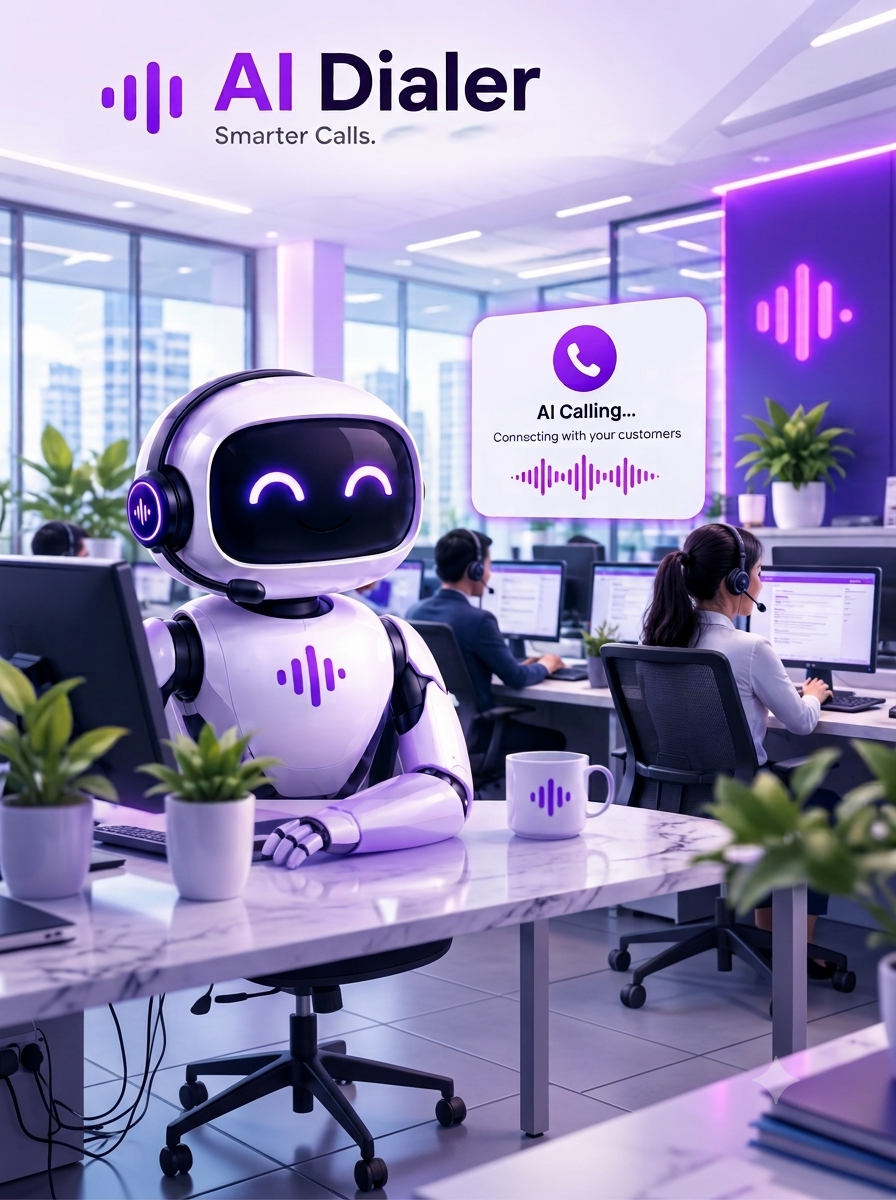
Connect with your customers faster, smarter and more efficiently with AI-powered calling.